
Have you been wondering a lot about why AIO, GEO, and AEO are the hottest topics in Search right now? To be honest, you are not alone in thinking about this!!
As AI becomes a major part of many industries, search optimisation is evolving, with tools like ChatGPT and Google AI making it easier for people to get answers quickly.
This shift is something iSearchSolution sees regularly while delivering SEO services across multiple industries, adapting to AI-driven search platforms. As you step ahead, this blog will walk you through the proper explanation of these three buzzing terms: AEO, GEO, and AIO, and you will understand why these are the latest hot subjects.
How Search Optimisation Evolved From the 1990s to AI Search in 2026
You might think search is just about keywords and links, but SEO services started long before that idea even existed. As search engines grew smarter, new tools and methods came along. These changes pushed SEO professionals to move away from shortcuts and focus on genuinely helpful content.
- The Beginning (1990-1997)
Archie is where the story of search systems begins in 1990, as it was the first search engine that indexed documents on the proto-internet. Not pages on the World Wide Web, but searchable content.
The first real web search engines, such as JumpStation. By the mid-1990s, it was the big names, Yahoo! and AltaVista, who showed the world how important it was to show that content was easily accessible.
- Google and the Dawn of SEO (1998-2015)
Then, Google created the PageRank system, where links were treated as votes and shifted the focus of SEO from keyword crunching to quality and real authority.
In addition, updates, such as Panda in 2011 and Penguin in 2012, punished spam content and link collusion, making everyone build content that is genuinely valuable. In 2013, Hummingbird brought a new focus to search engines as it understood meaning and not just words, and with this, the era of semantic SEO was born.
- The period of Mobile, AI and User Experience (2015-2022)
Mobile‐first, RankBrain, BERT, and Core Web Vitals brought the focus on user experience and understanding of the language front and centre.
- The AI Revolution (2023-2026)
The rapid rise of ChatGPT and Google’s AI Overviews, which provide instant answers with no links, shows that search engines are no longer about finding web pages. In real SEO services campaigns, AI answers are already replacing many traditional search clicks while increasing brand exposure.
Today, it’s about getting direct answers and helpful recommendations. Strategies like AEO and GEO help you make your content part of those answers rather than just a link.
AIO, GEO, and AEO: Explained
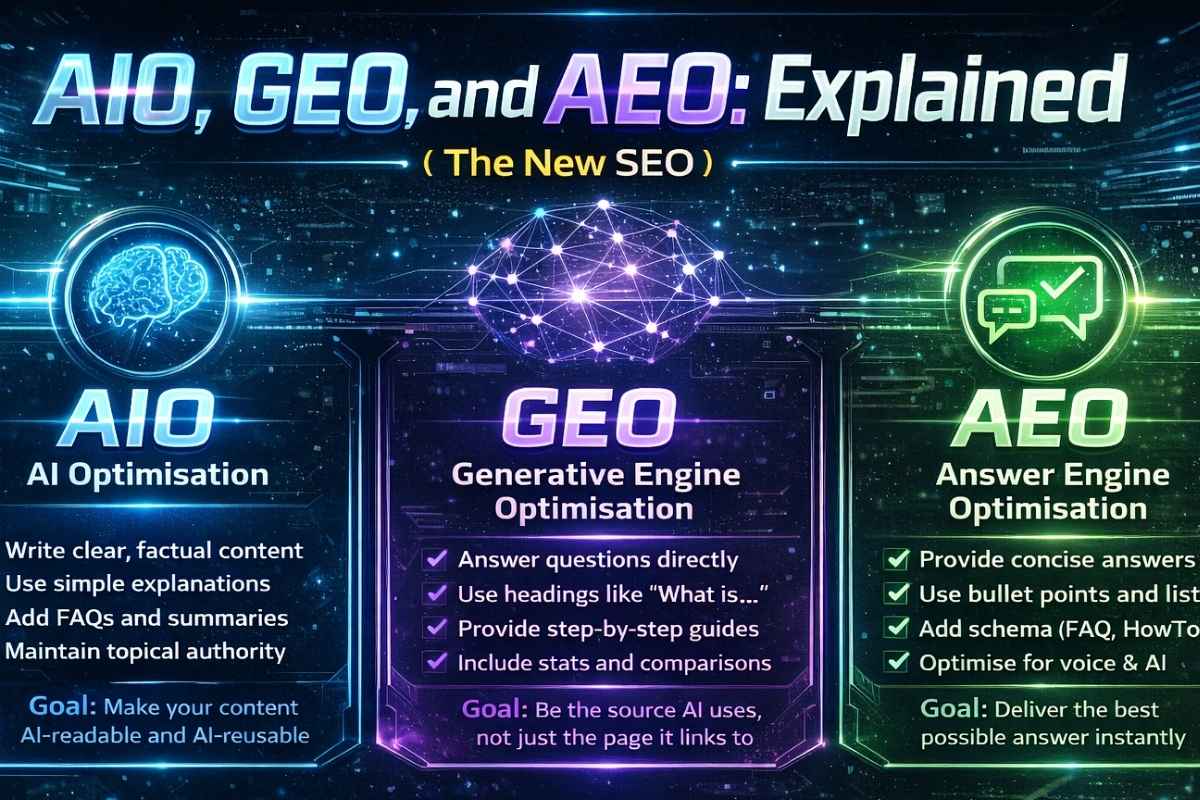
Today, you need to do more than just add website links, and that’s the point where AIO, GEO, and AEO are the hottest topics in Search right now. Many businesses are wondering how to adapt their content for this AI-driven world.
You want your content to be included in AI systems’ responses like ChatGPT, Gemini, Google AI Overview, and Perplexity. These systems optimize differently, so that your content isn’t just indexed but actually understood.
AIO: Artificial Intelligence Optimization
AIO refers to the approach in which users optimize their content so AI systems like ChatGPT and Bing Copilot can utilize the content for answering questions or generating summaries.
Key Elements of AIO
- Organized writing: You employ titles, bullet points, and short sections that are easier for machines to read.
- Unambiguous Content: It is evident that your writing is seamless, easy to read, and well describes the concepts, which aid in understanding for AI.
- Marking and Metadata: Using schema markup and metadata that tell machines exactly what your sections mean.
- Abundant Information: You clarify the answer. AI needs context to understand why the information is useful and the scope of your content.
Key Applications
- AI Summaries: AI systems generate concise summaries that include your main points instead of skipping over your document.
- Chat Responses: Services such as ChatGPT integrate your concepts to create conversational responses.
- Voice Assistants: Siri, Alexa, and similar devices verbalize and respond to your answers.
- Finding context: AI overviews and recommendations use your structured sections when answering complex queries.
Benefits of AIO
- AI understands your content correctly because it’s structured and context‑rich.
- Your ideas can now be used in a variety of formats, including summaries, chat, and voice replies.
- This helps AI understand the content better, so people get clearer and more accurate answers.
Clear, Relatable Examples
For example, if someone asks an AI, “How do I make a good cup of coffee?”, the AI can quickly summarize your steps and use them in its answer because it can easily understand your content.
GEO: Generative Engine Optimisation
GEO means you make your content clear and detailed so AI systems like ChatGPT, Gemini, or Perplexity can use it to give answers, not just show a link.
It can also make it even shorter and super simple, if you want it to be very easy for anyone to understand
Core Features of GEO
- Content organized for extraction: Small blocks that AI can pick up easily.
- Semantic clarity: This means using related words and ideas, so AI really understands what the topic is about, not just matching random keywords.
- Structured data and schema: Give clear labels and organized facts so AI can recognize the meaning of things, such as definitions, dates, and facts, without guessing.
Key Applications
- AI responses: It includes your insights in detailed answers and explanations.
- Long‑form summaries: AI tools can make longer summaries about topics by using your content as the base, so the final version describes what you said.
- Knowledge reuse: Artificial Intelligence should quote or reference your examples and data, so the generated results clearly show your work was used.
- Brand presence in conversational search: Your name appears when AI explains a subject, for example, a phrase, then a name, ‘Wikipedia’.
Benefits of GEO
- Your work becomes part of the stories AI tells people.
- Your content can be mentioned on many platforms, not just in search results.
- AI tools can share your ideas in answers, chats, and tools, so more people see them.
- This can still help you even if your site doesn’t rank high in old search results.
Clear, Relatable Examples
Imagine someone asks an AI, “How do I start a small café business?” The AI can take your step-by-step article and use it to give a full answer.
Or, if someone asks, “What are the best travel tips for Japan?” the AI can pull key points from your long guide and include them in its reply.
In other words, your content becomes the actual answer the AI gives, not just something the AI links to.
AEO: Answer Engine Optimisation
Assembling your content in a way that AI systems can use it directly to answer questions is AEO. Normally, when people search online, search engines just show a list of links. But AI-powered systems, such as Google AI Overviews, “People Also Ask” boxes, Siri, Alexa, ChatGPT, or Perplexity, can pull your content and show it as the actual answer to a question.
Core Features of AEO
- Ask the question first: Write your content around what people actually ask. It will help AI give the right answer.
- Give short, clear answers: Answer the question right away in simple words. Don’t make people read long paragraphs to find the point.
- Use a clear structure: Use formats like FAQs or step-by-step guides so AI can easily pick up and show your answers.
Key Applications
- Featured snippets: Your answer appears at the top of search results as a boxed answer instead of a link.
- People Also Ask: Your concise answer shows up right under the query box with other common questions.
- Voice assistant replies: Tools like Siri and Alexa read your answer aloud when someone asks.
- AI answer panels: Your content becomes the immediate response that users see without scrolling or clicking.
Benefits of AEO
- Your content shows up first for users’ questions.
- Your content is noticed even when people don’t click on search results. For businesses, this means visibility even when users never visit a website.
- Your text gives your users quick and clear answers.
- So, overall, searchers rely on your brand for getting the genuine answers.
Clear, Relatable Examples
For example, if they search “How to boil an egg?”, they see a box called People Also Ask. It shows clear steps right on the search page. That’s AEO.
Or, when someone asks a voice assistant, “What is SEO?”, and it reads out your content without sending them to a website, that means your content was chosen as the best direct answer.
A Comparative Breakdown of AIO, GEO, and AEO
For a clear understanding of the argument for ‘why AIO, GEO, and AEO are the hottest topics in Search right now, refer to the table below, which, along with the primary features, shows the key differences between AIO, GEO, and AEO.
| Strategy | Main Goal | Best For | Visibility OutCome |
| AIO | Help AI understand and use your content. | Machines & voice assistants. | Used in generative summaries & chat responses. |
| GEO | Make content reference‑ready for AI models. | Generative engines. | Your content is quoted or cited in answers. |
| AEO | Be the chosen answer. | Search results & voice assistants. | Featured answers or direct replies. |
Together, AIO, GEO, and AEO help brands stay visible across traditional search, AI answers, and voice-based results.
Does This Indicate the End of SEO?
Without a doubt, SEO will continue to be fundamental. From ongoing SEO services work, it’s clear that search engine marketing is evolving rather than disappearing.
However, people now search differently. Traditional SEO still helps bring traffic and visibility from search engines, but now it works alongside new goals as well:
- Being found (classic SEO)
- Being understood (AIO)
- Being cited (GEO)
- Being chosen as the answer (AEO)
If you use these strategies together, your content can show up everywhere your audience looks, from search engines to AI assistants and chat tools.
How AIO, GEO and AEO Changed My Search Strategy?
Since applying AIO, GEO, and AEO across SEO services projects, these strategies have consistently delivered stronger visibility in AI-driven search. I still remember the first time an article I wrote got quoted directly in an AI-generated answer, and not just ranking on page one.
After restructuring content into short, clear Q&As, the article began appearing directly in AI-generated responses. And I have realized how powerful this new approach really is. The best part? People stayed longer and read more because the writing was easy to understand and felt friendly. Even AI systems rewarded it.
Ready to Expand Your AI Search Strategy? Partner with iSearch Solution
Now that you’ve reached the end of this blog, you can see how search has changed and why content that answers questions clearly performs better in modern search systems. AIO, GEO, and AEO don’t replace good writing and strategy, but they help your content be understood, used, and shared across search engines and AI tools.
If you want more people to see your business online and get real results, iSearchSolution can help. With over 10 years of experience in SEO, they create smart strategies to improve your rankings and grow your online presence. So, to take your business to the next level, book a free consultation or contact iSearchSolution today to start increasing your traffic, rankings, and brand reach.