
Web design – the art of creating and designing a website. The most exciting thing about the internet is the fact that anyone can join it. If you’ve got something to share, the world is waiting to hear that. There is no need to spend much money; you can host a website for a reasonable amount. Of course, you can expect to pay for hosting with advanced features like more storage and databases.
Note that your website is not just a URL; it’s your brand’s identity. However, if you are promoting the business, you might prefer to commission professional designers. This guide helps you understand how a website designing company in Delhi operates.
Planning a Website
So, before designing a website, the top website designing company in India first thinks about its goal, competition, and audience. They determine how a business will organise its content, how visitors will interact with it, the site’s purpose, and more.
At its core, they help you prevent businesses from getting confused about the purpose of the site. Meanwhile, a major question arises: how will you compete? The competition is only one click away. It’s like, when someone sees a link of yours in search engine listings, chances are, they might see you as their direct competitors.
Meanwhile, the top companies often talk about having a USP, which is a fancy way of saying what differentiates them from competitors. However, they will think in terms of how the website benefits the visitors.
Fact: According to recent industry reports, over 80% of project delays happen due to unclear requirements. For this reason, top agencies invest heavily in this discovery stage.
Layout and Design
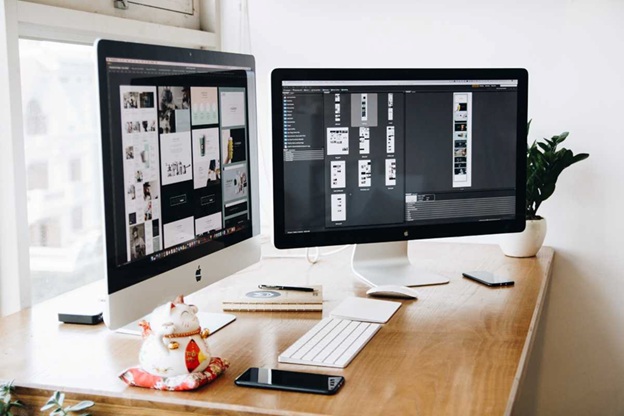
The layout of a website should communicate order and consistency so that the design of a site looks professional and easy to use. However, once the plan is in place, the next step is to develop a visually striking and user-friendly layout.
Define the look and feel of the design. The look and feel of the website result is derived from all the decisions a business makes about its content and design.
It is a combination of:
- The images you use.
- The attitude suggested by the text and the language it uses.
- Colour scheme of the site.
- Fonts are used to convey information and draw attention to important elements.
- Arrangement of elements on the page to accentuate what is important.
As legendary designer Paul Rand once said, “Design is the silent ambassador of your brand”. Top designers from leading companies like iSearchSolution use wireframes, prototypes, and UI/UX principles so that every section of the website has a purpose.
Designing Effective Navigation
Navigation, or the ease of moving around, is the backbone of a positive user experience. In a nutshell, it enables users to understand your site structure, find what they need, and explore everything your website has to offer.
A well-designed website uses clear menus, breadcrumbs, logical page hierarchy, call-to-action buttons, search bars, and mobile-friendly layouts. Even the studies show that 38% of users leave a website if the layout or navigation is confusing.
HTML: The Language of a Web
HTML is the standard markup language that aims to display documents in a web browser. It is a key innovative technology that has been significantly updated and expanded. But the purpose of formatting and structuring web pages remains the same. Once the company has established the prerequisites of a site, it will be ready to set up the HTML project.
Professional web designers make sure that every HTML structure is clean, semantic, and SEO-friendly. It could mean they use proper tags, headings, schema markup, and accessibility standards to let search engines understand the content.
The true power of HTML lies in its universal standard. Meaning, every single browser, be it Google Chrome, Apple Safari, Mozilla Firefox, Microsoft Edge, or Opera, is built to read and interpret it. HTML is administered by the World Wide Web Consortium (W3C). Therefore, a website built with proper HTML will definitely work today, tomorrow, and years from now.
Applying CSS

CSS, aka Cascading Style Sheets, is what gives your website its visual personality. CSS defines the presentation of a document written in HTML or XML. CSS brings the design to life with colours, typography, spacing, animations, responsiveness, and layout control.
Modern CSS tools like Flexbox, Grid, and animations let brands create visually engaging and user-friendly experiences.
The types of CSS a top website designing company in India may apply include:
- Inline CSS
This is typically applied when there is a demand to attach styles to the body of an HTML element. It goes like this, <p style=”color: blue; font-size: 16px;”>This is a paragraph with inline CSS.</p>.
- Internal CSS
It is placed within the HTML document and looks more organized than inline CSS. The only bummer is that it could not have the modularity of external stylesheets. Here is an illustration of internal CSS:
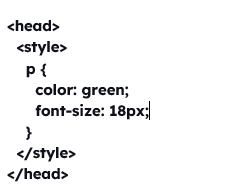
- External CSS
External one entails a different CSS file having a .css extension. This is then linked to the HTML document. Here is a simple example for the same:
<head>
<link rel=”stylesheet” type=”text/css” href=”styles.css”>
</head>
Partnering with the top website designing company in India gives businesses a strong advantage. With their precise understanding of UI/UX principles, they improve page readability, user flow, and page loading speed with optimised stylesheets, establish cross-border compatibility, and a lot more.
JavaScript For Interactive Pages
JavaScript is a full-fledged programming language. It transforms the site with sliders, pop-ups, animations, live chats, forms, and other interactive elements. In addition to this, it converts static pages into dynamic ones. Companies work by employing a combination of core language features, the Document Object Model (DOM), and an ecosystem of frameworks and libraries.
JavaScript is applied to almost all websites for the purpose of validation. Instead of this, it supports external applications like PDF documents, supporting flash applications, running widgets, and more.
Content Management System
Once the site is all dolled up, a website design company creates a CMS-based website by understanding the client’s requirements, choosing the right platform, creating a custom theme or features, and ensuring the site is functional, responsive, and secure.
They might rely on platforms like WordPress, Shopify, Magento, and Drupal to allow clients to update content easily, without the need to have technical expertise.
For example, if a business wants to sell online, then an e-commerce website designing company in Delhi employs advanced CMS features like inventory systems, payment gateways, cart management, customer accounts, tracking, analytics, SEO tools, and more.
Today, CMS vendors and industry players put overarching emphasis on “customer experience management”, which can drive all your digital investments. Overall, when we look carefully, CMS comprises many parts.
Testing and Launching
To keep the site relevant and in optimal working condition, the website designing company in Delhi continuously reviews usability and iterates on the basis of feedback. Before it goes live, the site goes through speed testing, security audits, mobile testing, browser compatibility checks, bug fixing, UX testing, and performance optimization.
| Do You Know 🤔?
According to Google, 53% of users abandon sites that take longer than 3 seconds to load. |
A dedicated QA (Quality Assurance) or test engineer runs the usability test and opens up a wealth of observations relating to how users experience the site in real time. From navigation to ease of use and task completion to design elements, they reveal them all.
Final Words
Throughout the years, we saw new elements and styles emerging in web design. Some may help the user navigate through the site, while some may tell a story. At the end of the day, all the elements have the potential to improve the visitor’s experience.
Before you start digging into creating your own design, consider meeting a professional team. As mentioned in this post, a website designing company in Delhi can prove helpful in many ways.
They are aware of the fact that web design is more than aesthetics. It is a harmonious blend of strategy, psychology, technology, and creativity. If you want a website that engages, attracts, and converts, know that choosing the right partner makes all the difference.
FAQs
Q1: How can I develop a website?
A: In case you have technical expertise, then you can create it on your own. Otherwise, you need to search for a top website designing company in India and find the best out of many.
Q2: Why should I hire a website design company in Delhi?
A: Your partnership with a website designing company in Delhi gives you access to experienced professionals and digital strategists who understand modern market trends. Otherwise, a business can hire them for high-quality custom design, better user experience, mobile responsiveness, SEO, fast website loading time, and consistent branding.
Q3: How much does it cost to hire someone to design your website?
A: Website designing in India can range from approximately ₹5,000 to ₹20,000 for a basic static website and ₹1,00,000 or more for complex e-commerce or custom web applications.
Q4: What are the 5 golden rules of web design?
A: The 5 golden rules of web design include useful or original content, ease of navigation, responsive design, layout consistency, and the creation of URLs that are easy to remember.
Q5: What is better to hire, a freelancer or an agency?
A: Both have their own set of pros and cons. Freelancers have a limited capacity that might be challenging for large-scale projects. On the other hand, agencies provide scalability and adaptability to align with the demands of different project sizes and scopes.